Programming Languages
- C
- C++
- Java
- Python
- JavaScript
- PHP
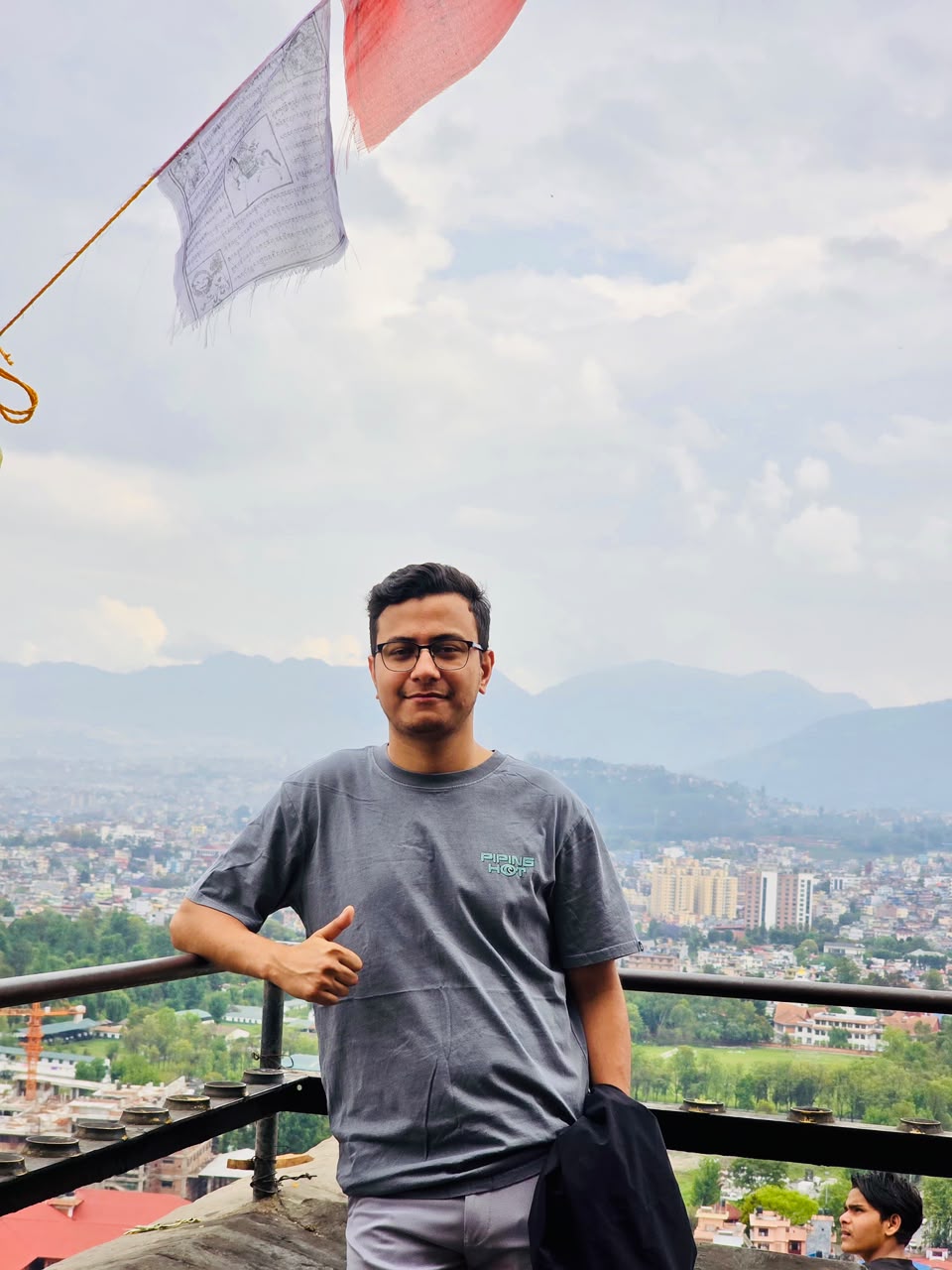
// hello world, I'm
Software Developer · Computer Science Graduate
Building practical software through code, design, and intelligent systems — from web applications and databases to machine learning models and well-considered interfaces.
// 01 — about
I hold a Bachelor of Science in Computer Science and Information Technology (BSc.CSIT) from National College of Computer Studies, Kathmandu, affiliated with Tribhuvan University. My academic path has given me a solid foundation in programming, data structures and algorithms, database systems, and software design — and I've used that foundation to build real, working projects rather than just study theory.
Across my project work, I've built with C, C++, Java, and Python for core logic and system design; PHP, SQL, and JDBC for back-end and database-driven applications; and HTML, CSS, and JavaScript for front-end interfaces. I've also applied Python and scikit-learn to machine learning tasks like classification and prediction, and used Figma to design user flows and high-fidelity interfaces before a single line of code is written.
What interests me most is the full picture — how a database schema, a back-end service, a trained model, and a front-end interface come together into one coherent system. I enjoy tracing a problem from a rough idea to a working solution, and I'm comfortable moving between backend logic, web application development, and interface design depending on what a project needs.
I'm currently looking for internship, junior developer, and collaborative software opportunities where I can contribute to real-world products, learn from experienced engineers, and keep sharpening both my technical and design instincts.
// 02 — technical skills
Skills below reflect hands-on familiarity built through coursework and independent projects — not formal certification levels.
A rough, self-assessed view of breadth across domains — not a verified proficiency score.
// 03 — featured work
A closer look at the projects that best represent range across web development, machine learning, and interface design.

A personalized web-based reading platform that helps users discover suitable reading material, track reading activity, and receive recommendations powered by a machine-learning model that estimates reading time and suggests content based on user behavior.
Demonstrates: full-stack development, applied machine learning, database design, UX for learning tools.

A full-stack browser-based system for managing parking slots, vehicle entry and exit, and fee calculation, with a PHP back end handling record storage and a responsive front end for daily operation.
Demonstrates: full-stack integration, CRUD workflows, practical system design.

A machine-learning classification project that predicts glass type categories from measured chemical and physical features, comparing model performance and analyzing generalization.
Demonstrates: applied ML workflow, model evaluation, analytical reasoning.

A high-fidelity UI/UX design for an online art marketplace, covering distinct buyer and seller journeys from browsing and artwork detail pages through to a complete purchase flow.
Demonstrates: user-flow design, visual hierarchy, prototyping for real product journeys.
// 04 — full archive
Console-based parking application built with structured programming. Vehicle records are modeled as an array of structs with fields for slot number, plate ID, and entry timestamp, with linear search driving lookups on exit and fee calculation.
Rebuilds the same problem as a layered Java application: model classes for slots and vehicles, a JDBC data-access layer for persistence, and a relational schema that keeps entry, exit, and fee records queryable instead of held only in memory.
Separate Book, Member, and Transaction classes keep borrowing logic decoupled from inventory state, with base/derived class relationships for member types so shared behavior lives in one place instead of being duplicated.
Nets each person's balance down to a single value, then greedily matches the largest debtor against the largest creditor on every pass — a recursive min-max settlement that collapses many pairwise debts into a handful of transactions.
Featured projects above — Personalized Reading System, Parking Management System (Web), Glass Classification, and the Art Marketplace design — are also part of the full archive.
// 05 — education
National College of Computer Studies, Kathmandu — affiliated with Tribhuvan University
2022 – 2026
A comprehensive program covering programming fundamentals, data structures and algorithms, database management systems, software engineering, machine learning, and web technologies — applied throughout via project-based coursework spanning console applications, database-backed systems, and machine-learning models.
// 06 — how I work
Start by mapping requirements, constraints, and the actual workflow a system needs to support before writing any code.
Sketch data models, user flows, and architecture — in Figma for interfaces, or on paper for logic and database design.
Implement in small, testable pieces, using version control to track progress and keep changes reviewable.
Check edge cases, validate against real inputs, and refine logic, layout, and performance before calling it done.
// 07 — strengths
Professional, responsible, and committed to following organizational standards and project requirements — while contributing ideas and asking questions that improve the outcome.
// 08 — now
Updated July 2026
Finishing up my BSc.CSIT coursework while sharpening the machine-learning side of the Personalized Reading System, and spending time going deeper on data structures and system design ahead of internship applications. Also using this portfolio itself as a small ongoing project — most of the recent interface and performance details on this site were built and refined after the fact, not part of the original coursework.
Next up: going deeper on backend system design and distributed systems fundamentals, getting more comfortable with cloud deployment (beyond static hosting), and picking up TypeScript as a natural next step from JavaScript.
// 09 — uses
// 10 — coursework & certificates
Placeholder badges below — swap in real course/certificate names once available. See the README for instructions.
// 11 — endorsements
Note: double-check the quote wording below matches what Ram actually said before publishing — the name and relationship are set, but the exact phrasing should be confirmed with him.
"Dipesh consistently approached assignments by first understanding the full system before writing code, which showed in how cleanly his projects were structured. A dependable, detail-oriented developer to work with."
// 12 — notes
Short write-ups on specific decisions from the projects above.
On treating reading speed as personal rather than a fixed words-per-minute constant, and what that meant for the model.
Read more →A note on deriving parking-slot availability from records instead of a separate status flag, and why that avoided a class of bugs.
Read more →Walking through why matching largest debtor to largest creditor, recursively, minimizes the number of transactions.
Read more →// 13 — coding activity
Project source code, experiments, and ongoing work are tracked on GitHub. Explore the repositories below for implementation details on any project featured in this portfolio.
Loading live stats from the GitHub API…
Visit GitHub Profile// 14 — lessons learned
Skipping straight to the wins felt incomplete — here's what actually went wrong on a couple of these projects, and what changed after.
An early version of the Parking Management System tracked slot availability as a separate true/false flag alongside the entry/exit records. An edge case left a slot marked occupied with no matching record, and there was no clean way to tell which was right. The fix was to stop storing availability at all — it's now derived from whether an active record exists. See the full note for details.
The first version of the Personalized Reading System's time estimate used a single fixed reading speed for everyone. It technically worked, but it wasn't personalized in any real sense — the whole point of the feature. Rebuilding it around per-user reading history took longer, but it's the version actually worth showing.
Several rounds of feature additions to this site (command palette, live GitHub stats, offline support, and more) were built in quick succession without stopping to verify each one on a real device first. A mobile layout bug shipped as a result before being caught and fixed. Slower, more deliberate testing between rounds would have caught it sooner.
// 15 — faq
Available starting after graduation in 2026 — reach out any time before then to discuss timing for internships or early-start roles.
Based in Kathmandu, Nepal, and open to remote roles. Open to relocation or on-site work for the right opportunity — happy to discuss specifics directly.
Internships and junior/entry-level developer roles — front-end, back-end, or full-stack, with a particular interest in roles that touch web development, databases, or applied machine learning.
Nepali citizen. For roles outside Nepal, happy to discuss visa/work-authorization specifics directly — reach out via the contact section below.
// 16 — contact
Open to internships, junior developer roles, and collaborative projects. Reach out directly or send a message below.

Scan to open this site on your phone — handy for career fairs or after a chat.